
Lion Blau
On-chain social product
Moment is a mobile-first app that lets people capture and permanently store moments on-chain — turning everyday photos into owned, timestamped artifacts. Instead of building another feed, I designed a ritual-first experience: capture → commit → preserve — where memory feels intentional, not disposable.
Nov - Dec 2025
Nov 2025 — Jan 2026 · Role: Product Design, Frontend, System Architecture
Role: Product design, front-end, data architecture, automation

PROBLEM
Feeds broke memory
Modern social apps optimize for volume — endless posts, fleeting stories, and algorithmic feeds. As a result, nothing feels important anymore. At the same time, NFTs introduced ownership — but remained speculative, complex, and disconnected from everyday behavior.
What’s missing is a simple, native action:
→ Capture a moment. Make it permanent.
FEED

High volume, low meaning
MOMENT

A single moment —
Intentional, owned, permanent
PRODUCT DIRECTION
From feeds to rituals
Instead of designing another social feed, I focused on a different interaction model:
Memory should feel like a decision, not a scroll.
This led to a clear product bet:
-
No infinite feed at the core
-
No passive consumption
-
A single, intentional action: capturing a moment
The experience centers around:
-
A live camera
-
A timestamped capture
-
A visible “commit” moment (minting)
Only after this ritual exists does social behavior emerge on top.
The experience is built around a simple, three-step loop:
CAPTURE

Capture → t=0s
→
STRUCTURE

Structure → t=+1s
→
COMMIT

Commit → t=+3s
Written on-chain & owned by user
A simple, three-step ritual turns a capture into a permanent, timestamped record
EXPERIENCE DESIGN
Capture → Commit → Own
The product was designed as a tight loop:
-
Capture
A familiar camera interface lowers friction
-
Commit
The moment is “etched” — turning a casual photo into a deliberate action
-
Own
The result becomes a permanent, user-owned object on-chain
The UI removes all blockchain complexity and keeps the experience close to a native camera app — while still exposing ownership when it matters.
.png)
/home
.png)
/camera

/preview

EVOLUTION
From private archive to social layer
Once the core ritual worked, the next step was introducing social behavior.
Instead of copying existing feeds, the product extends into a full-screen, swipeable stream of moments — similar to TikTok, but structured around permanence and timestamped records.
Key differences:
-
Each item is a timestamped, immutable record
-
Metadata (time, wallet, origin) is part of the content
-
Interaction remains lightweight (view, like, explore)
This creates a hybrid:
→ A swipeable stream where each item is a permanent record, not disposable content

Feed view
Immutable after commit
Swipe to navigate between records
Linked to creator wallet
Timestamped at capture
Each item is a permanent record — not disposable content
SYSTEM DESIGN
Making on-chain invisible
To support this experience, the system had to behave like a single, reliable product — not a collection of blockchain steps.
The key design challenge:
Turn a multi-step minting process into a single user action
This required:
-
Coordinating image upload + metadata creation
-
Triggering contract interactions
-
Returning a usable moment instantly in the UI
The result:
→ A system where “minting” feels like pressing a button, not executing a workflow
In the UI, this reduces to:
Tap → Processing → Confirmed
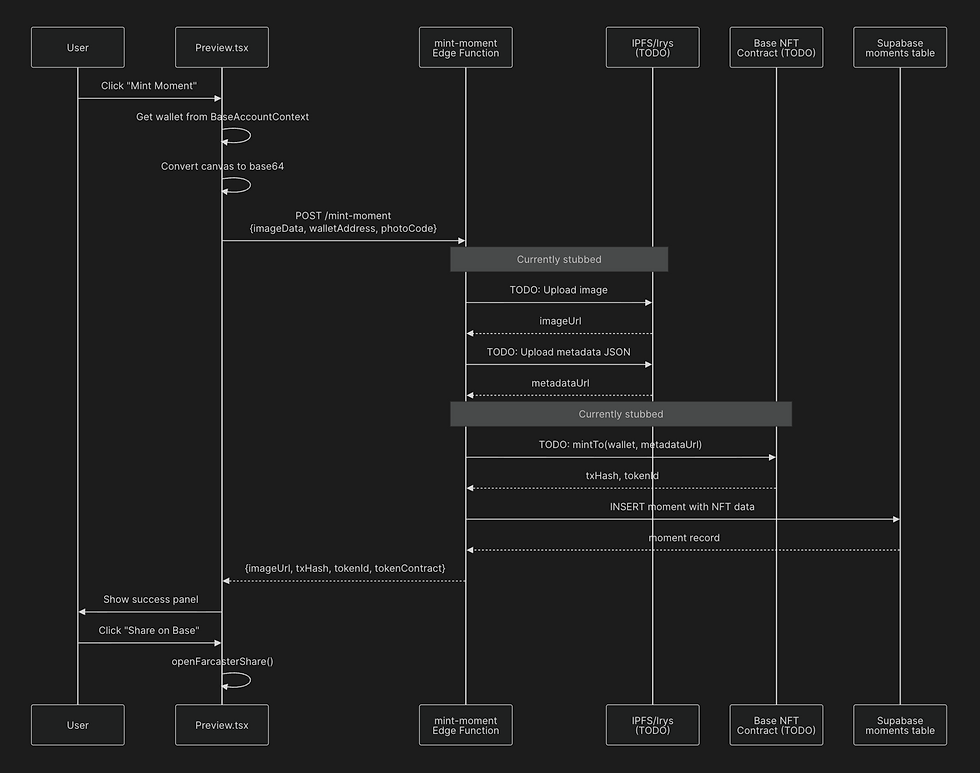
Turn a multi-step minting process into a single, predictable user action
DISTRIBUTION
Every moment becomes a shareable entry point
Instead of relying on a central feed, distribution is built into each moment itself.
Every capture produces:
-
A shareable link
-
A consistent preview (OG image)
-
A portable, timestamped record
This allows moments to travel across platforms — from chat to social to marketplaces — without additional formatting or effort.
→ Each moment is both content and distribution infrastructure
How moments spread:

Moment → Source of truth
→

Chat → Direct sharing
→

Base → Distribution loop
→

OpenSea → Secondary discovery
LEARNINGS
Designing systems, not screens
To make “ownership” feel real, the product couldn’t expose blockchain steps —
it had to behave like a single, predictable action.
Building Moment shifted my focus from interface design to system behavior:
-
The core UX decision was not the camera UI, but collapsing minting into one action
-
Perceived speed mattered more than actual on-chain confirmation time
-
Trust came from clear state transitions (capture → commit → confirmed), not technical transparency
Key takeaways:
-
Simplicity is a system design problem, not a UI problem
-
The mental model (what users think is happening) matters more than the actual architecture
-
AI accelerated execution — but product clarity determined what got built

NEXT
Deepening the experience
Next steps focus on strengthening the core loop:
-
Making the “commit” moment more expressive — turning confirmation into a memorable event
-
Evolving the social layer from passive viewing to meaningful interaction (responses, reactions, context)
-
Reducing latency between capture and confirmation to reinforce the feeling of immediacy
The goal is to evolve Moment from a working prototype into a behavior-defining product —
where capturing, owning, and sharing feels fundamentally different from existing social tools.
Moment explores a simple idea:
What if memories were actions, not content?
Product Strategy
Marketing surface: OG images and shareability
Making Moments Shareable (On & Off-chain)
As an integral part of the product itself, Moment’s (social) marketing layer was designed to feel cohesive and instantly recognizable. OG images, social preview cards, and landing visuals all echo the in-app experience, making every link to Moment feel like a doorway into the same universe.
-
Dynamic OG templates: Auto-generated visuals that pull in
-
Consistent branding: The same gradients, typography, and iconography appear from social previews to the app shell.
-
Clear messaging: Copy emphasizes ownership, moments, and base deployment without overwhelming non-technical users.
Push distribution — Structured updates delivered through Telegram for fast, lightweight monitoring.

Push distribution — Structured updates delivered through Telegram for fast, lightweight monitoring.

Coming up next...
Next steps now focus on depth rather than breadth. On the product side, the priority is a tighter visual redesign, stronger UI patterns, and more deliberate motion so Moment feels as polished as a modern social app. On the technical side, the goal is to wire in real‑time blockchain data so new mints, ownership changes, and activity show up instantly in the interface instead of relying on manual refreshes.
Moment will also move from a purely personal archive toward real social presence, with in‑app feeds, social views of etched moments, and ways to discover what others are minting on Base. Customization will expand with configurable time marks on photos, optional sound layers, and support for short video moments, all using the same on-chain format. In parallel, a desktop experience will make it easier to connect wallets, use in‑app browsers, and, over time, open the door to additional chains and wallet providers while keeping Base as the primary home. Together, these steps turn Moment into a Base‑native mini‑app that feels instant, social, and extensible across devices and ecosystems.

Learnings and next steps
What Bui(dl)ing Moment Taught
Building Moment showed what it actually takes to vibecode a real product on Base: a small, focused “mini‑app” that is platform‑specific (built for Base first) but still interoperable with the wider onchain ecosystem. Moment now behaves like a compact, opinionated app that can live inside Base‑centric contexts (Base App, Farcaster, marketplaces) while still exposing standard NFT primitives that other tools can plug into.
The main learnings were clear. Vibecoding with tools like Lovable, Vercel, GitHub, and AI support makes it possible for a single builder to own the full stack, but only if the architecture stays simple and observable. Building directly on base reduces infra choices and lets more energy go into product decisions instead of multi‑chain complexity, while still leaving room to expand later. And finally, the story gets much stronger when infrastructure, UX, and marketing (OG images, share flows, listings on places like OpenSea) are all treated as one product, not separate tracks.
The process
Moment wasn’t hand‑coded from scratch; it was built by vibecoding the stack together in Lovable, then tightening everything with GitHub, Vercel, and a lot of AI‑assisted debugging. The goal from day one was clear: an AI-built direct‑to‑Base photo app where a user takes a picture, hits mint, and an NFT is created automatically without them needing to understand the plumbing.
Backend and blockchain flow
The core of the work went into getting the backend and blockchain pieces to behave like a single, predictable system. Using Lovable, the mint flow evolved into: the frontend sends a “mint moment” request to an edge function, that function uploads the image and metadata to storage, talks to the Base smart contract (which was deployed via Manifold under a specifically created "MMNT mint" wallet) to mint the NFT, then writes a clean record into the database so the app can show it instantly. A lot of the iteration here was about making sure the contract calls, IPFS / file storage, and Supabase writes stayed in sync and failed gracefully instead of silently breaking.
Vibecoding the full stack
Because the app was vibecoded end‑to‑end, the process was less “big spec then build” and more “ship, break, fix, repeat” in full speed. Lovable generated the initial React/Next.js frontend and API routes, GitHub kept version history and branches for experiments, and Vercel handled instant deploy previews so every change could be tested live. When things broke — wallet connection edge cases, Base RPC errors, type mismatches, or deployment issues — AI tools were used heavily to inspect stack traces, explain unfamiliar errors, and propose concrete fixes until the whole mint pipeline ran reliably.

PerplexityAI Assistant live, clicking on GitHub for debugging

Vercel Deployments manual through GitHub and vibecoded with Lovable

BE and FE Vibecoding on Lovable, here debugging React issue
Research & Insight
While NFTs exploded in 2021–22, most of that activity was speculative trading of 10k collections and profile pictures, not simple, everyday tools people actually use. Trading volumes have fallen sharply, and a large share of NFT collections are now effectively “dead,” with little activity or obvious utility. What is still missing is a direct‑to‑blockchain photo app that feels as simple as taking a picture on your phone, but writes that moment on‑chain by default and can evolve into a social layer on top.
On-chain social and NFT photo products exist, but they’re mostly marketplaces bolted onto Web2 feeds or heavy decentralized networks that feel like infrastructure, not apps. Crypto‑native users still lack a simple way to “just post a photo to chain” in something that feels like a normal product, especially now that pure NFT trading hype has cooled and attention is shifting toward social, utility‑driven use cases.
Base and the upcoming Base App are leaning into exactly this space, combining onchain apps, social, payments, and Farcaster primitives (like Frames) into a consumer‑friendly surface. That’s why Moment ships on Base first: it’s a direct‑to‑Base photo experience that can start as a personal archive and later plug into Base App, Farcaster, and other onchain social surfaces, while keeping the architecture open enough to expand to other chains or even web2.5 entry points like Telegram or LINE in the future.

.png)
Designing for Emotional Permanence
Modern apps trivialize memory — endless posts, fleeting stories, no true ownership. The challenge was to craft a digital experience that treats memories as emotional objects, and those deserve structure, ownership, and permanence, preserving human moments with authenticity.
We wanted to achieve three interconnected goals:
-
Design a lightweight mobile-first product experience centered around memory creation.
-
Design and vibecode a backend that can reliably take a captured photo plus some basic context and turn it into a clean, versioned “moment” object ready to be stored both off‑chain and on Base.
-
Vibecode the frontend so the entire flow — capture, confirm, mint, share — feels like a normal photo app, with the blockchain complexity hidden behind clear, minimal UI.
-
Deploy immutable, user-owned “moments” to the Base blockchain — ensuring transparency, permanence, and user sovereignty
-
Deploy smart contracts simple enough to maintain and quick to ship, but robust enough to become the foundation of an on-chain social product later.
/home
/camera
/preview


